
1.90–2.10 mm
Target: 2.00 mm · Tolerance: ±0.10 mm
1.902.002.10 mm
2.08 mm is within the previous range.Independent research · Living Knowledge
Helping people keep pace with change accelerated by AI — through knowledge that stays connected to the work.
See what changes ↓
Knowledge that stays useful
as work changes.

The human side of change
AI can multiply the volume and pace of changes people need to understand. Operators, engineers, and managers still have limited time to rebuild the picture after every update.
Living Knowledge is an independent research initiative exploring how to keep that picture current, connected, and understandable. FourLens is the method.
A concrete example · Cold-rolled steel coil
A customer’s order calls for a narrower thickness band. The strip still targets 2.00 mm — but a reading that was acceptable before now needs attention.
Target: 2.00 mm · Tolerance: ±0.10 mm
Target: 2.00 mm · Tolerance: ±0.06 mm
2.08 mm is now 0.02 mm above the allowed maximum. Flag it for quality review using the approved plant procedure.
Illustrative order change: 1,000 mm strip width and specified minimum yield strength below 260 MPa. The ranges belong to this example; production decisions follow the applicable order specification and approved plant procedure.
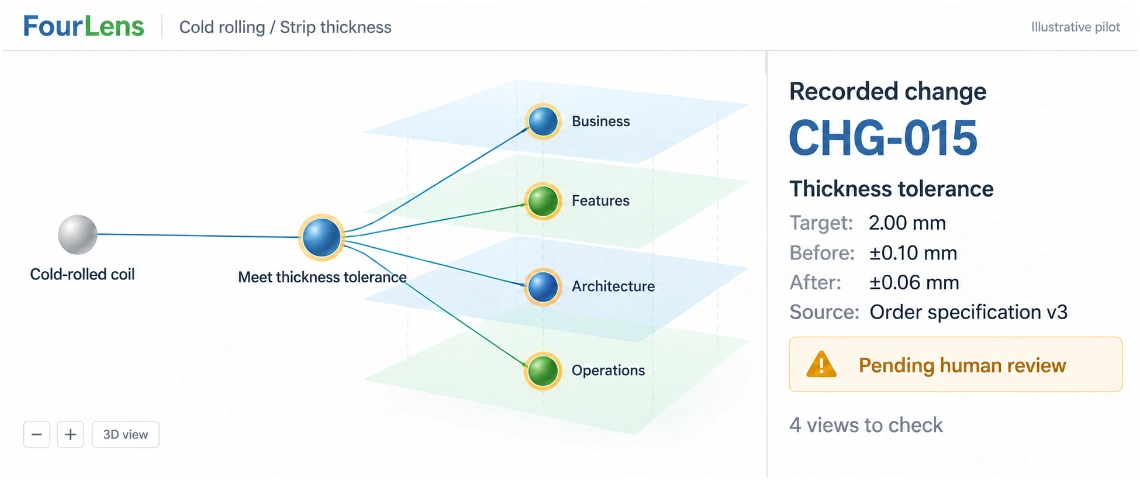
The FourLens method
Every change has more than one consequence. FourLens connects the purpose of the work, what people can do, how the pieces fit, and how the work is carried out.
The purpose, value, and responsibilities behind the work.
Thickness exampleMeet the customer’s dimensional requirement.
The capabilities needed to check and respond to a change.
Thickness exampleCheck thickness against the current limits.
The connections between people, information, and systems.
Thickness exampleConnect the gauge, rolling control, and quality check.
The practical guidance teams use to carry out the work.
Thickness exampleMonitor the trace and flag sections outside limits.
A proposed way of working
An engineer or AI proposes an update to the work.
FourLens updates the connected views, with links to supporting evidence.
Experts check the meaning and consequences. Teams act on approved guidance.
Workers flag gaps and contribute practical experience to the next update.
After Living Knowledge
CHG-015 tightens the thickness band for the same 2.00 mm strip. Each person gets a practical answer from the same connected picture. Any role can explore all four views.
To fulfil the customer’s order and avoid shipping strip outside its limits.
No. It exceeds the new 2.06 mm upper limit. Flag the reading for quality review.
The exit gauge feeds thickness control, which adjusts the roll gap. The target stays at 2.00 mm.
Watch the thickness trace. Flag sections outside 1.94–2.06 mm using the approved plant procedure.
The intended benefit
A new tolerance is more than a revised number in a document. The team can connect the customer’s requirement to the measurement, the control system, and the action on the shop floor. The intended outcome: less repeated clarification, earlier recognition of out-of-limit readings, and more consistent action against the same requirement.
Where the research stands
The prototype already supports source-based explanations, a review interface, and versioned updates in a narrow internal test case. Broader industrial validation is still ahead.
Keep the conversation going